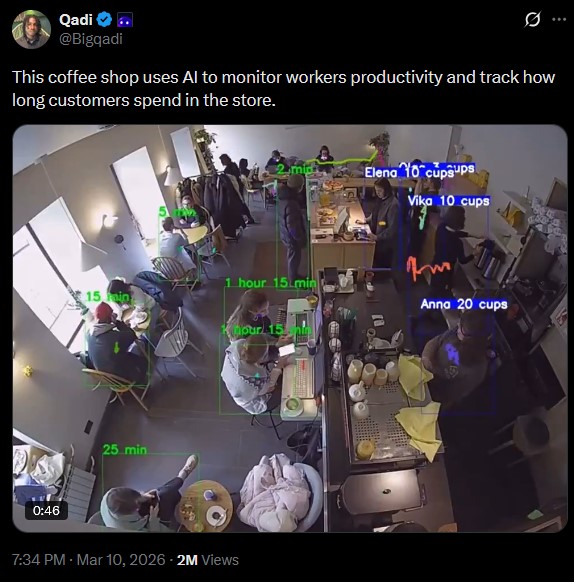
The left side of this video still is what is granted to the right side and vice versa to keep them locked in capitalist relations without revolt. The worker can at least spend, and the consumer is sustained from their labor. This ends up being unfreedom on both ends. They are both a consequence of the class relation, and both mutually help obscure the conditions of their existence. Accepting this arrangement means you’ve naturalized what should be a political a contestation.
In this blind spot, power can render you disposable, instrumentalize you, and threatens you always with deprivation. It will always be able to do this downstream of the capital-labor relation evading conscious mediation from those who create society’s wealth. Without conscious control over this process, those who produce and reproduce themselves as worker-consumers leave themselves to be managed. It takes a system to reproduce these two aspects of capitalist life. They don’t just happen without the management of these loose ends taken as totality. The unconsciousness of this relation creates space for alienated power, and thus class.
With a broken subjectivity that sees work and consumption as reified, detached moments, some force has to make the reproduction sustainable. All worker-consumers become data points. This video is the broken subjectivity of capitalism, and stages capitalist individualism’s reinforcement. The two sides dwell within their reified moments, and what evades their conscious experience is the management of society, which has now fit them into its scheme behind their backs.
We always sense a big Other lurking in our disavowed social situations, and our alienation creates space for a mechanism to capture such space. We are right to sense a big Other is possible, it flows naturally from how we relate, but we open this space by our reified practice in capitalist society. Our practice both reifies pathology at the individual psych level, and helps make pay for a real world power to exploit and naturalize what is conjured in the pathological response. A big Other is substantialized, but we can in fact claim that space back for ourselves.
The two sides of the image still above switch places routinely, always pitted against one another, seeing the two aspects of their lives as unrelated. In this absence of solidarity or sustained social contextualization, everyone falls prey to capital’s mechanisms of control. A capitalist class solidifies its power by keeping itself on the right side of capital’s mediations. A space is carved out for a big Other, and the capitalist class flows into that space. People work and consume without view of society, but society remains anyway. A ruling class was given the opportunity to manage and control society via this alienation.
As long as we let labor and consumption each drive us back into the reified consciousness of capitalist individualism, there we be a force that capitalizes. It will claim for itself the direction of society, and it will dominate our existence, both directly and impersonally. The unavoidable impersonal mode of domination will be captured and maintained by a class of barbarians. They rule over us and have the added advantage of us experiencing their rule as a natural condition. It doesn’t ever require them to announce that we are their property.
Commerce and labor are wedded to the capital-labor relation, and to exchange. For us to overcome capitalism and class society, labor and consumption must be taken out of the exchange relation, and out of socially unconscious, for-profit mediation. We should produce to care for each other. We should take from production in service of need, as should be our birthright. We should reinforce the social bond on both ends by abolishing exchange, which means no longer necessarily pointing people back at their self-interest. Being a worker-consumer is capitalist society is to have an entire system always point you back at yourself, and tether you to capitalist modes of exchange and competition, one side at a time, and this must necessarily obscure the totality.
Not to suggest we would have restaurant services like the above images this in a better world, but just for the sake of example: if those on the right side of the video still were led to do the work through their own will, whether as a desire to cook, or a desire to help their community, they would simultaneously be taking control of the social totality. Laboring to stave off deprivation and/or afford individualistic consumption leaves the space of the totality to be claimed by a malign force, that will render human beings into data points only to be managed.
The worker has to think of survival first, even if they enjoy the work, and the social practical meaning is captured by capital. The consumer is reinforcing that relation through their aim for independence in a context where freedom can’t be granted. The consumer consumes in relation to a social Other, that it also must always disavow, or act as if it is competing with, instead of seeking. Both laborer and consumer are stuck in themselves, but necessarily so.
To take control of society would be for either side of this video to have a direct connection to their experience, even if part of gaining this direct meaning is itself through processes of collective mediation. That mediation should of course be open to shaping from all hands. The consumption that transcends this video isn’t consuming as a replacement for or against society, and the worker works understanding themselves within society and dependent on it. Being created as a consciously social individual would be what drove them to their work.
 Forces At Work